
With the release of Watchmen comes a lot of hype and anticipation for the graphic novel turned movie. The graphic novel, originally published as a series in 1986-87, has long been heralded as the best novel of its kind. Time Magazine even listed it as one of the 100 Best Novels.
There is a reason there was so much hype around this story of “superhero” characters. Watchmen changed a genre and turned superhero comics into stories of real-life with real life lessons.
Storytelling has long been an effective means to affect people in profound ways, from the days of Homer (the Greek poet), to the days of Homer (the Simpson). Watchmen is no different of a story, with compelling life lessons in the story, hidden (or maybe not-so-much) in between the gritty, dark journey of the characters.
Before going on with the Watchmen Movie Review, I do want mention a few things. First, Watchmen isn’t a kid’s comic and therefore some of the themes and images aren’t exactly G-rated. With that in mind, I’ve tried to keep this post mostly suitable for work (MSFW), and all of the life lessons that I saw were positive–it’s just the context from which they came may not be seen that way.
Second, I cover the whole gamut of the story in this Watchmen Movie Review, so you can probably piece together the story through the lessons. If you haven’t read the book or seen the movie, continue reading at your own risk (aka this is a “possible spoiler alert”).
Life Lessons Learned from Watchmen Movie Review:
“Don’t Tell Me They Didn’t Have a Choice.”
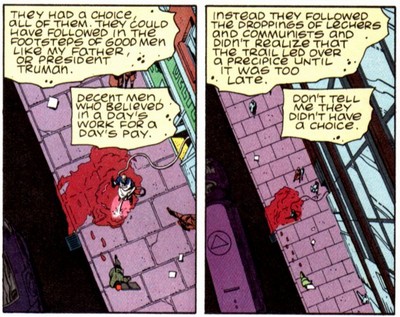
Rorschach’s first journal entry states it plainly: everyone has a choice. Whether it’s to be involved in a nuclear arms race, or to be stuck in a dead-end job, people make a choice to be where they are.
While many people wait around for something to happen, the people who find success are those that decide they will go out and get it. As Eisenhower said, “The history of free men is never written by chance but by choice–their choice.”
“Gettin’ old, you get a different perspective.”
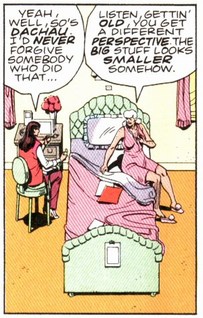
While the particular incident Sally Jupiter is referring to is quite extreme, her point-of-view is still valid and one that many people don’t realize until they get older. Whatever your age is, think back 10 years ago and think about what you thought was important at that time. Is it still important? If you were in high school 10 years ago, was it really important what clothes you were wearing or even whether it mattered that you got a 95% instead of a 97% (yes I got upset about that).
In the long run, when lying on your death-bed, no one wishes they would have spent more time at work or even made more money, they wish they would have enjoyed life more and spent time with their friends and family. Why wait until death to wish that? Start doing it now.
“Nothing is hopeless.”
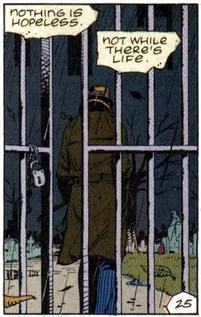
As long as there is life, nothing is hopeless. Certainly there are times we all reach rock-bottom, where things seem insurmountable, but that’s the amazing thing about the human spirit. Even when we’re down at the bottom, there is always hope. We can make changes, we can take the action necessary to move in the right direction.
Just look to a number of inspirational stories such as the “Miracle on the Hudson” where Pilot Chesley B. “Sully” Sullenberger III safely landed a plane on the Hudson River, saving all 155 passengers. Look at the “comeback” stories of high-profile celebrities like Mickey Rourke. Or even look at leaders such as Martin Luther King, Jr. He must have known that he wasn’t going to end racism by himself, but he still dreamed, and he still took action to make it a reality.
“I feel as if I’ve been here all the time.”
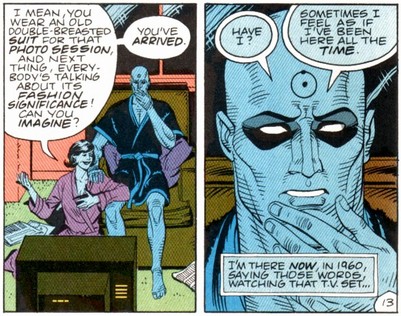
Though Doctor Manhattan is also referencing his metaphysical sense of time, his view on having “always been here” is an accurate one. Janey Slater suggesting that “he’s arrived” because he now has fame and notoriety is inaccurate. People hold certain accomplishments up on a pedestal thinking they will only be successful when they reach that step, but success is different for every person.
Becoming CEO of a company doesn’t mean you are more successful than a stay-at-home Mom that has raised 3 children–the measures of success are different. The key is to define your vision of success and work to achieve it. And specifically on the concept of fame, recall that Ralph Waldo Emerson observed, “Fame is proof that people are gullible.”
“Things have their shape in time, not space alone.”
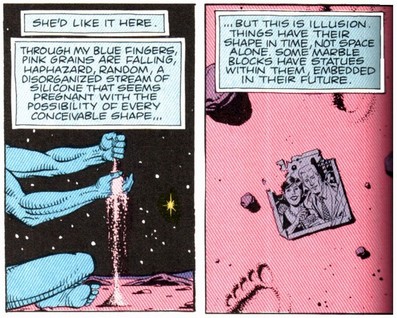
George Bernard Shaw said, “You see things and say ‘Why?’ But I dream things that never were and say ‘Why not?'” Doctor Manhattan’s observes that what is now just a block of stone can one day be the Statue of David.
The same is true for people. Every person has the opportunity to do something unique, something powerful. And while it may not be that way right now, hard work and perseverance can make that change; it’s hidden underneath the stone, just waiting to be chiseled into the next masterpiece.
“Even the word ‘gone’ would be gone.”
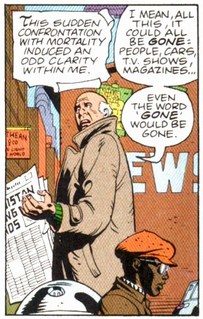
Bernard’s first thoughts when thinking of a disaster turn to the obvious of people, cars, etc. But then he has a realization that bigger things, like the construct of language and that of societal interaction would be gone as well, and that’s the bigger disaster. This is much the same as how many people view life–they think of the material things and material girls. But rarely do we step back and appreciate something as simple as social interaction–friends, family, community, and even enemies.
Similar to Sally’s observation above, what’s going to be more important to you as you get older, and therefore, what is more important for you to focus on now?
“My Perspective.”
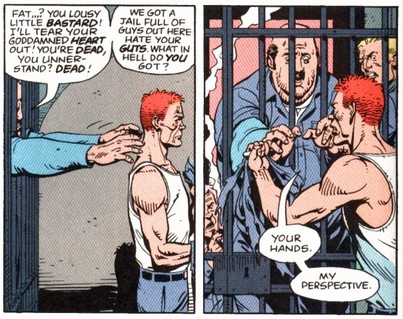
Whenever Rorschach speaks, it is short and to the point. Here, in the face of what seems to be an impossible situation, he has two things on his side: perspective and confidence. And these two things are often what will allow people to succeed in the face of adversity.
Based on your experiences, you have a unique view of every situation, and that perspective is what makes you different from everyone else out there. Whether it’s as a writer, actor, project manager, or barista, your perspective will be different. Combine that with having confidence in yourself and your abilities, and just as Charles F. Kettering said of the Wright Brothers, you can fly “right threw the smoke screen of impossibility.”
“You could say that about anybody in the world.”
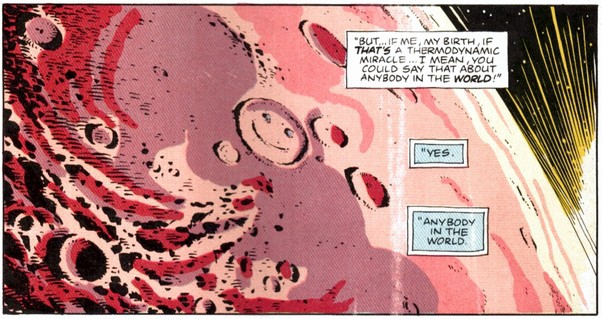
The thermodynamic miracle referenced by Laurie Jupiter is that of birth, and Doctor Manhattan has realized that the odds required for people to get together and have this child or that child is a miracle; a miracle that is true of anybody in the world.
Sometimes it’s easy to lose sight of the miracle of life, and as cheesy as it sounds, every person does have the opportunity to make their own unique impact on the world–the question is what will yours be?
“Offices below, headstones marking daily graves of thousands.”
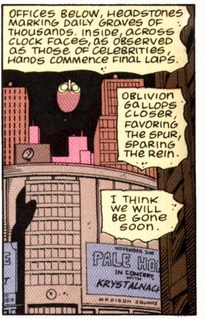
In Rorschach’s final journal entry, he shares again a different perspective (both literally and figuratively). Literally, up above the city, the skyscrapers and buildings do look something like tombstones in a cemetery. Figuratively, living only to work may not be physical death, but is it really living? Is working 80-hour weeks, neglecting friends and family or unique life experiences, really the Hokie Pokie (that’s what it’s all about)?
Burg’s Philosophy holds true for the time you spend at work, as well as in life: “It’s not the time you put in, but what you put in the time.”
“No time like the present.”
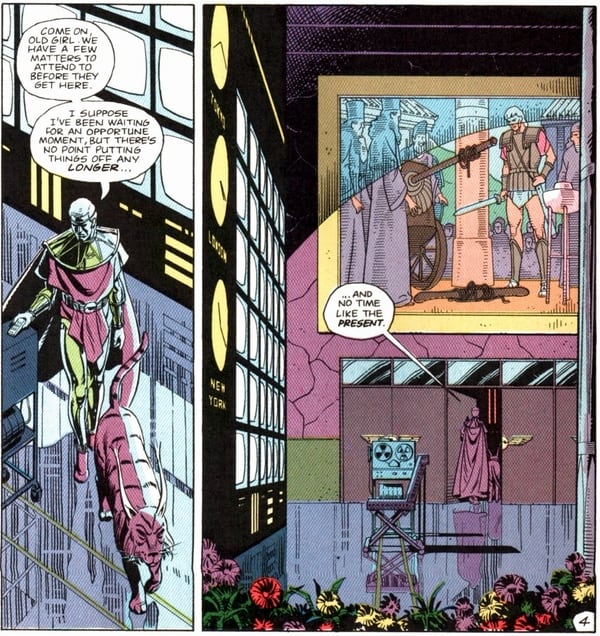
Perhaps, like Ozymandias, you have a plan or idea of something that you want to do, but have been waiting for the “perfect” time to do it. Well the perfect time was yesterday, so you might as well do it today.
People will find all kinds of reasons to procrastinate (“the timing’s not right,” “the weather is gloomy,” “‘The Hills’ is on”), but you only need that one good reason to do it, that one reason that starts you on your new plan or idea, and that reason is: there is no time like the present. After all, it is called the ‘present’–it’s a gift for us to use. And it may not turn out perfect, or you may not know what will happen, but don’t forget…
“The excitement of not knowing.”
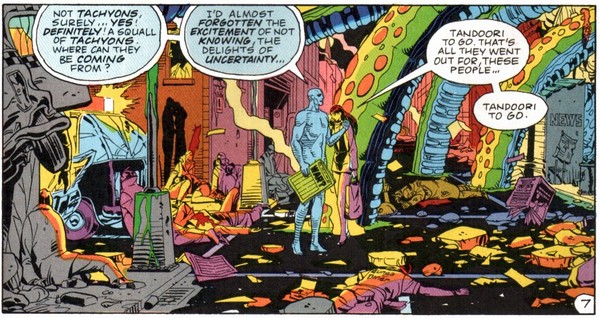
One of the scariest things about trying something new–acting on a plan or idea you had, or moving in a different direction–is the uncertainty of what will happen. But that’s also part of the excitement.
If you had the option to see the future, would you want to be able to? As Doctor Manhattan discovered, it takes the fun and surprise out of living. It’s like knowing the end of Sixth Sense, The Usual Suspects or Watchmen before even seeing the movie–sure you can watch the movies and still be entertained, but you won’t get that same sense of enjoyment and satisfaction when the twist is revealed.
“Nothing ever ends.”
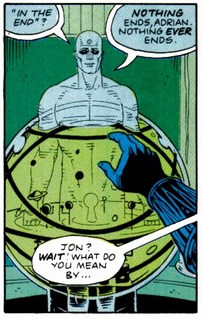
I know plenty of people that believe if they just get a certain job, or make a certain amount of money, or even buy a certain gadget, that they’ll be happy, that everything will be perfect. But “in the end,” nothing ever ends. Even if you get that job, life continues on after. You’ll have new adventures and new challenges, but not everything will perfect. But who would want it to be? Our failures lead to successes, and we appreciate them more.
Life is not just about the awards, statuses, or objects we obtain, but the journey we took to obtain them–we will spend much more of our time on the journey than on accepting the awards. So as you work toward your goals, hopes, or dreams, make sure the path you take is one you enjoy. Thomas A. Edison knew this well: “I never did a day’s work in my life. It was all fun.”
Source
Watchmen is a great story with compelling characters–there’s a reason it’s one of the top 100 novels. If you’re interested in reading the book (which you should), you can pick it up at Amazon.com.
Watchmen. Moore, Alan and Dave Gibbons. New York, NY: DC Comics, 1986, 1987.
I watched the movie on netflix today. I thought the movie was ok, but the ideas it explored I found intriguing. Particularly Dr. Manhattan. Living in the past and present. Staying on earth but not really being part of the earth and finally moving on.
Also the authors take on the true value of humanity, life, experience, convenient lies and hard truths.
I enjoyed your blog post. It highlighted areas of the movie I hadn’t given as much thought to and makes me want to buy the book.
Thanks David, I’m glad you enjoyed the post and I share your love for the graphic novel. A fantastic story.
I absolutely love Watchmen, but I’ve never really tried to apply anything from the book to real life. I have to say that this is one of the most inspiring things I have ever read. I’m going to bookmark this page and read it everyday.
Thanks Nigel, I learn something new each time I go back through the novel.
I’m suprised that nobody has commented on this, especially after the movie’s release. Watchmen is a great comic and this is an awesome interpretation. Thank’s for making it!